The monthly campus-wide seminar was held on September 30, 2026, at the Konso Meeting Room, ILRI Campus, featuring a presentation by Alemayehu Seyoum Taffesse on “AI and Low-Income Countries: Choices, Constraints, and the Role of CGIAR.” The presentation is a work in progress and sought to initiate a systematic dialogue on the opportunities, constraints, and implications of artificial intelligence (AI) in low-income countries.
Opening the discussion, Alemayehu noted that although AI is rapidly advancing globally, relatively little is known about its actual impacts in low-income countries. He argued that a systematic discussion is therefore overdue, particularly within CGIAR, about how AI can be adopted effectively—not whether it should be adopted.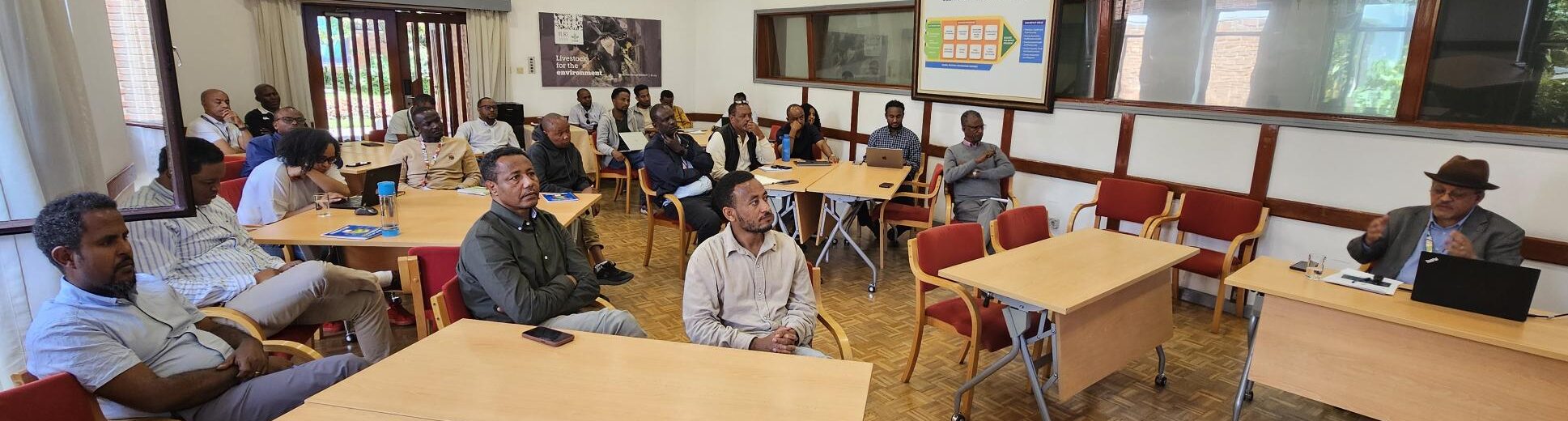
Five key claims
Alemayehu presented five main claims:
- Almost nothing is known. Five studies, no generative trial, no system-level effect of AI isolated.
- The choice of technique comes before the constraints – starting with Wheater to learn at all
- The risk is irrelevance, not disruption
- What can AI do about it. CGIAR has two roles. Ai inside its own research, and adapting AI with, not for national institutes.
Alemayehu emphasized that there is still very limited rigorous evidence on the impact of AI in low-income countries. Across the 25 countries classified as low-income, there are currently very few completed randomized evaluations of generative AI applications. He highlighted an ongoing IFPRI-led randomized trial in Kenya examining the use of large language models (LLMs) for farm advice, led by Gashaw Abate and expected to run through March 2027.
The emerging evidence also suggests that simply providing a good AI tool does not guarantee an impact. In some cases, AI may successfully relax a knowledge constraint, while the binding constraints lie elsewhere; for example, in effort, incentives, supervision, or the availability of complementary services.
This reinforces the central message that AI does not work by itself; it operates as part of a larger system.
Generative AI is only one part of the picture
The discussion also highlighted the need to look beyond generative AI. Generative AI is only one branch of AI, and in many contexts, other forms of machine learning and AI-enabled technologies may be more appropriate.
Five questions for every CGIAR AI proposal
A key takeaway from the presentation was that CGIAR projects involving AI should clearly address five questions:
- Which input does the proposal relax, and is that input actually binding?
- Does the problem require learning, and if so, is generative AI the appropriate approach?
- Who will pay the recurrent costs, and in which currency, after the grant ends?
- Who will maintain the system in year three, and could the national partner do so without CGIAR?
- What evidence would tell us that the intervention did not work, and who decided this in advance?
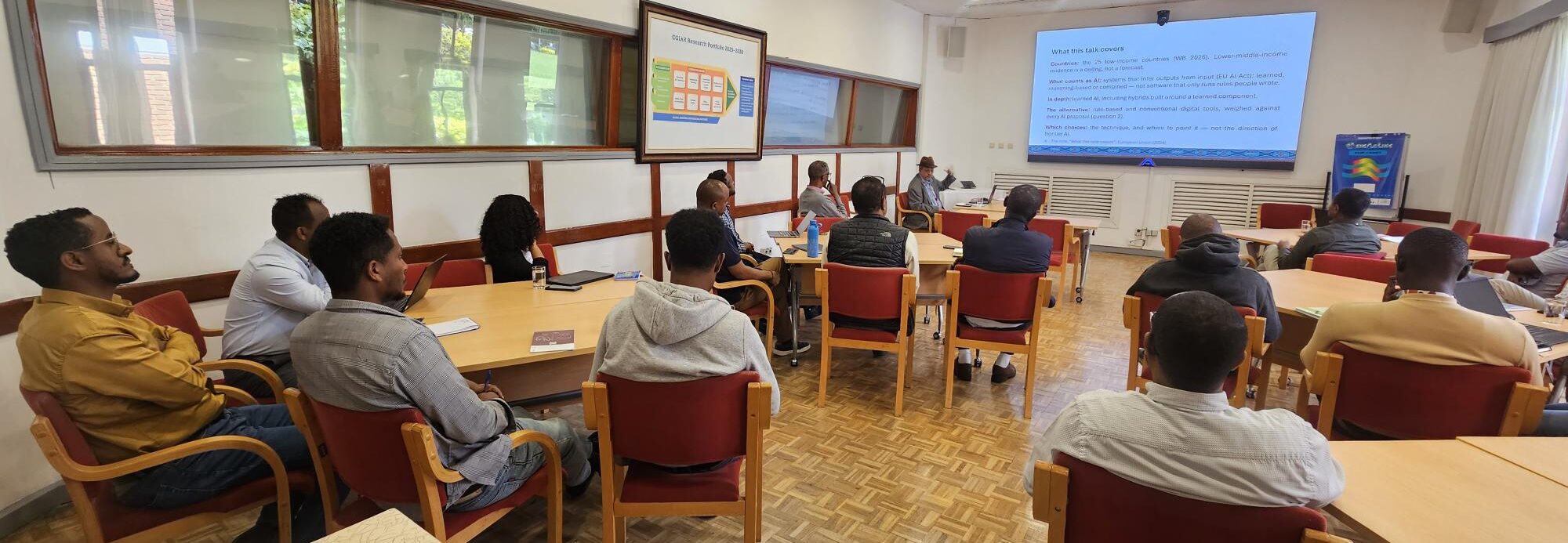 Alemayehu emphasized that if a proposal cannot answer all five questions, it should be treated as a pilot, with an appropriate budget and evaluation framework.
Reflections from participants
The presentation generated a wide-ranging discussion among participants.
Wubetu described the presentation as thought-provoking and broad in scope. He reflected on the role of CGIAR in AI, particularly in relation to agriculture and agronomy. He noted that AI is likely to affect the broader economy and that decision-making and advisory processes at higher levels could increasingly be supported by AI. He also agreed on the importance of evaluation, noting that AI should be viewed as part of a process rather than simply as an output.
He highlighted an important role for CGIAR in calibrating these processes and understanding how impacts are captured at the grassroots level, including how learning environments for LLMs can be improved and directed toward the needs of users.
Amare questioned the relationship between choosing a technique and identifying a problem. He also emphasized that data sharing remains a major challenge in developing countries and should be considered alongside AI adoption. He noted that improvements in the process may be an important outcome of AI, but ultimately, its value depends on whether those improvements translate into meaningful outcomes.
Sintayehu discussed the integration of machine learning and deep-learning technologies into existing systems. He emphasized the importance of making the technology user-friendly and working with governments and national institutions rather than assuming that CGIAR should own and operate these systems indefinitely. He raised questions about how LLMs could be implemented with government partners over the longer term and stressed that validation can differ significantly across local contexts.
Sam raised the question of whether AI should be expected to solve constraints that are themselves outside the technology. For example, if limited smartphone access is the binding constraint, the question should be whether that constraint should first be addressed rather than assuming AI can overcome it.
In response, Alemayehu clarified that the focus on low-income countries is driven by the need to better understand impacts in settings where robust evidence remains limited. He emphasized that the lack of rigorous impact measurement is not unique to low-income countries; even in richer countries, there remains limited evidence on measured outcomes and impacts.
The seminar provided an opportunity to begin this conversation within CGIAR and highlighted the need for continued dialogue, experimentation, and rigorous evaluation as AI becomes increasingly integrated into agricultural research and development.