The second CGIAR Campus-Wide Seminar Series was held on August 3, 2026, at the Info Centre Meeting Hall, ILRI Campus, Addis Ababa, bringing together more than 30 senior researchers and scientists from CGIAR Centers, Science Programs, Accelerators, and bilateral programs. The seminar provided an important platform for researchers across the CGIAR community to exchange knowledge and discuss how science can better support climate adaptation and resilience.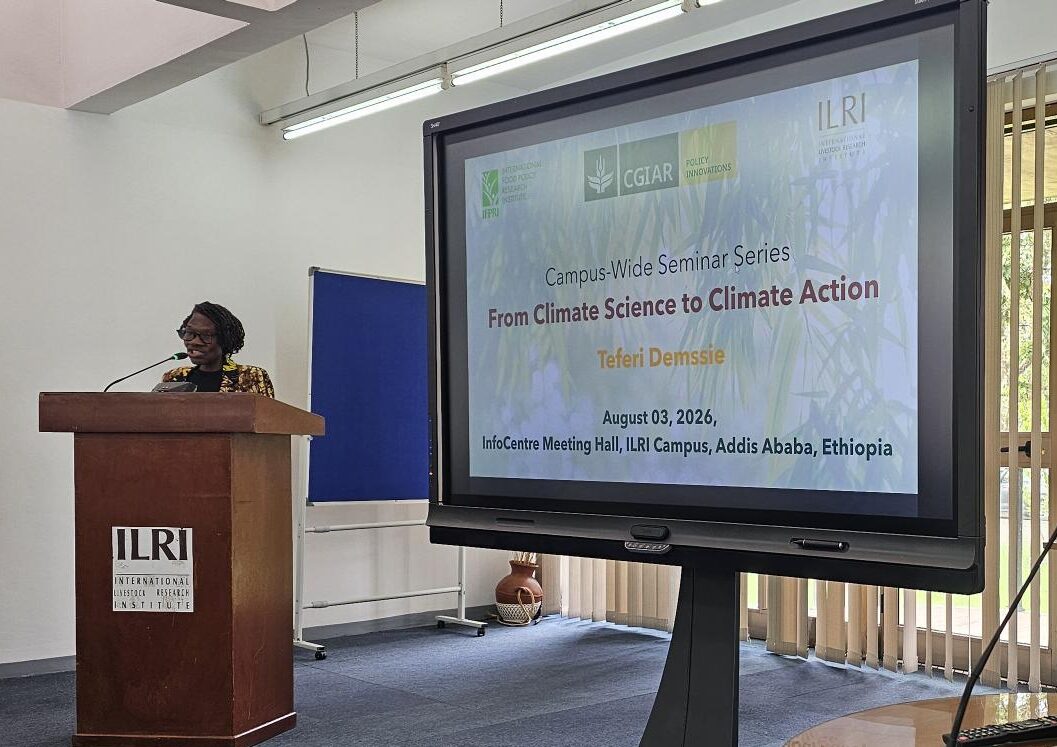
The seminar opened with welcoming remarks by Alemayehu Seyoum Taffesse, Program Leader at IFPRI-Ethiopia, followed by opening remarks from Namukolo Covic, who emphasized that climate change is no longer a distant or future challenge—it is already shaping agrifood systems, water resources, ecosystems, public health, livelihoods, and development pathways across the globe. She noted that while CGIAR has a dedicated Climate Action Science Program, climate considerations should be embedded across all research areas. She challenged researchers to accelerate the pace of climate action and work collaboratively to transform climate science into meaningful solutions that create impact on the ground.
The keynote presentation, "From Climate Science to Climate Action," was delivered by Teferi Demissie, Senior Scientist for Climate Information and Agro-Advisory within ILRI's Livestock, Climate and Environment Program. His presentation provided an accessible overview of climate science while highlighting practical approaches for translating climate information into decisions that improve resilience.
Teferi began by distinguishing weather from climate, explaining that weather refers to short-term atmospheric conditions, whereas climate describes long-term weather patterns over many years. He explained that the Earth's climate system is driven by the interaction of the atmosphere, oceans, land, vegetation, ice, and human activities. He further distinguished climate variability, such as El Niño, La Niña, and the Indian Ocean Dipole, from climate change, which represents long-term shifts in climate primarily driven by increasing greenhouse gas emissions and is already affecting every region of the world.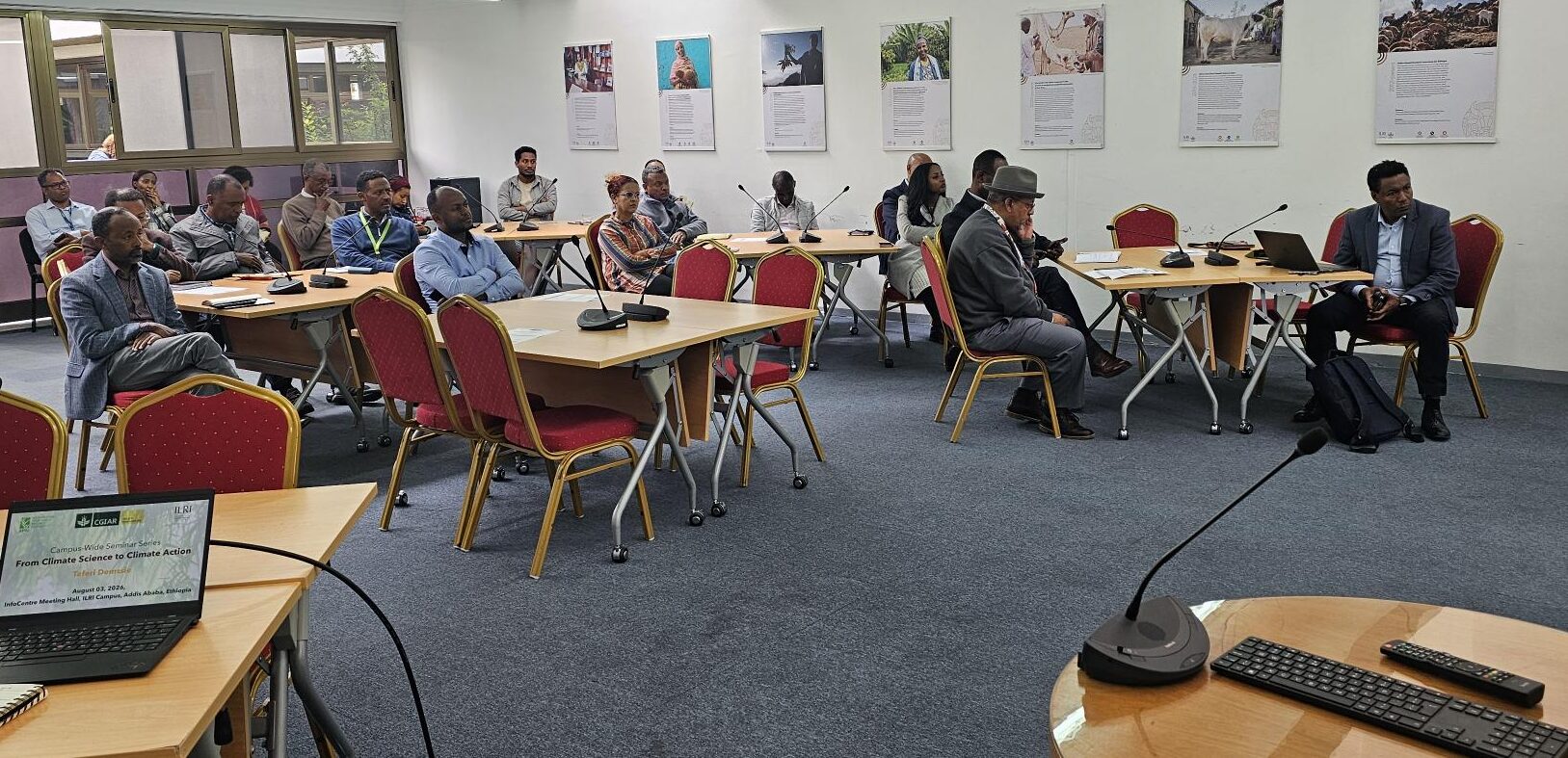
The presentation highlighted the growing risks posed by climate change and the urgent need for early action. Teferi discussed the climate paradox in East Africa, where some long-term projections suggest increased rainfall while others indicate declining rainfall in certain regions, illustrating the complexity of climate forecasting. He emphasized that climate risk results from the interaction of hazards, exposure, and vulnerability, making accurate information essential for reducing losses and building resilience.
A significant portion of the presentation focused on weather forecasting and climate services. Teferi explained that reliable forecasts rely on multiple data sources, including weather stations, satellites, radar systems, ocean observations, and numerical weather prediction models. He stressed that inadequate observational data remains one of the biggest barriers to producing accurate forecasts. He also illustrated how communities have traditionally predicted rainfall using indigenous observations, including animal behavior such as donkeys raising their ears before rainfall, emphasizing the value of local knowledge while noting its limitations for long-term forecasting.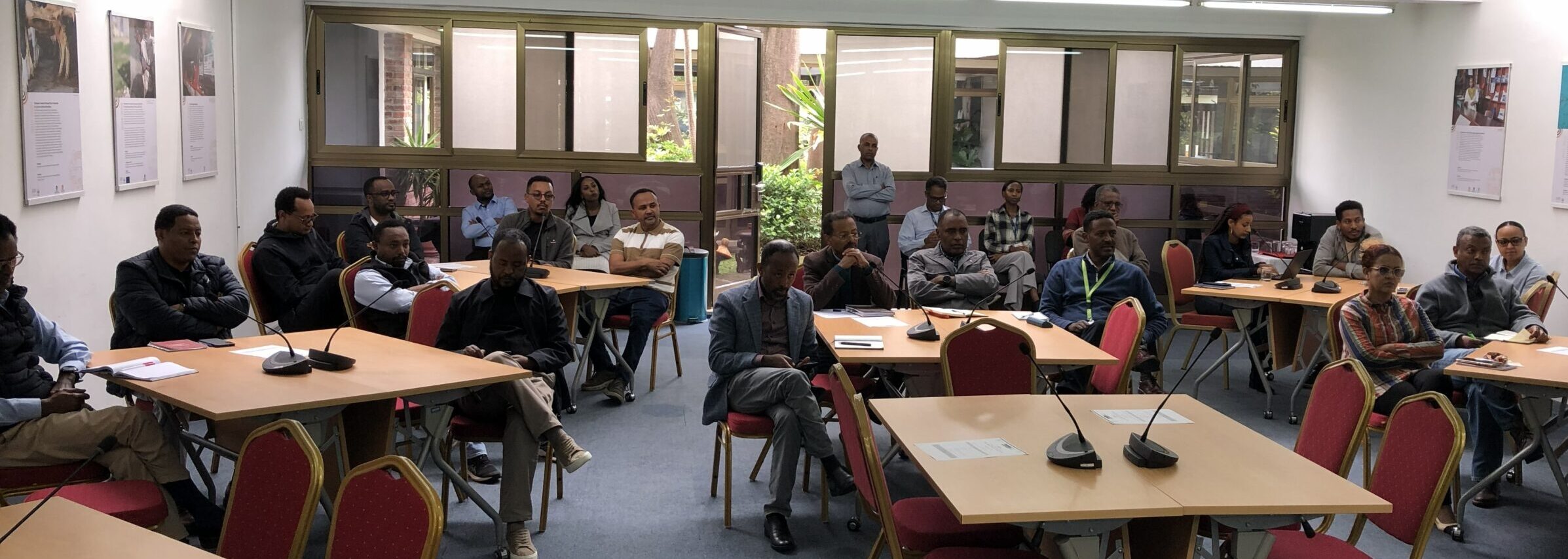
The seminar also demonstrated how climate services convert scientific information into practical guidance for decision-makers. Climate information supports agricultural planning, including planting and harvesting schedules, drought preparedness, crop yield forecasting, and risk assessment. It also contributes to public health through heatwave alerts and disease forecasting, supports water resource management through flood forecasting and water availability monitoring, and improves planning in the energy sector. Integrated climate and early warning systems ultimately save lives, protect livelihoods, reduce economic losses, and strengthen resilience across multiple sectors.
Teferi outlined the four key pillars of an effective early warning system: risk identification, observation and monitoring, communication and dissemination, and response capability. He highlighted existing dissemination channels, including SMS, mobile applications, radio, television, social media, and ATI's hotline service, while emphasizing the need for more integrated communication systems that ensure timely information reaches vulnerable communities.
Despite significant progress, Teferi acknowledged several persistent challenges affecting climate services, including limited observational infrastructure, insufficient data sharing among institutions, forecasting uncertainties, communication gaps, inadequate technical capacity, and limited financial resources. Addressing these challenges, he noted, will require stronger collaboration among institutions, improved investments in climate observation systems, and greater commitment to open data sharing.
The presentation generated an engaging discussion, with participants praising both its scientific depth and practical relevance. Questions focused on improving dissemination of climate information, strengthening collaboration with the Agricultural Transformation Institute (ATI), overcoming institutional barriers to data sharing, integrating indigenous knowledge with scientific forecasting, communicating uncertainties in weather predictions, and strengthening public trust in climate forecasts. Participants also discussed whether climate change could produce localized positive outcomes, such as increased rainfall in some regions, while recognizing that the overall global trend remains one of rising temperatures and increasing climate-related risks.
Responding to the discussion, Teferi acknowledged that stronger partnerships and coordination are essential for improving climate services. He highlighted ongoing collaboration with ATI through initiatives such as AGWISE and emphasized the need for better coordination among government institutions responsible for climate information and disaster risk management. On data sharing, he stressed that collaboration among research institutions is critical for improving forecasting accuracy and noted ongoing efforts to encourage institutions to make climate data more accessible. He also recognized the importance of indigenous knowledge, explaining that while local forecasting practices provide valuable insights, integrating them with scientific forecasting remains challenging, particularly when making long-term climate projections.
In her closing remarks, Namukolo Covic drew attention to COP32, which Ethiopia is preparing to host, describing it as a unique opportunity for CGIAR to demonstrate its collective contribution to climate action. She encouraged researchers and Centers to work together to develop a shared narrative, identify opportunities for collaboration, and leverage CGIAR's scientific expertise to support Ethiopia's climate agenda. Participants agreed to establish a dedicated discussion and coordination platform, with support from ILRI's IT team, to facilitate collaboration and prepare coordinated contributions toward COP32.
The seminar reaffirmed that addressing climate change requires more than scientific understanding—it demands stronger partnerships, better communication, improved access to climate information, and coordinated action across research, policy, and practice. As the CGIAR Campus-Wide Seminar Series continues, it is providing an important forum for bringing together diverse expertise to transform evidence into action and strengthen the resilience of agrifood systems across Africa.