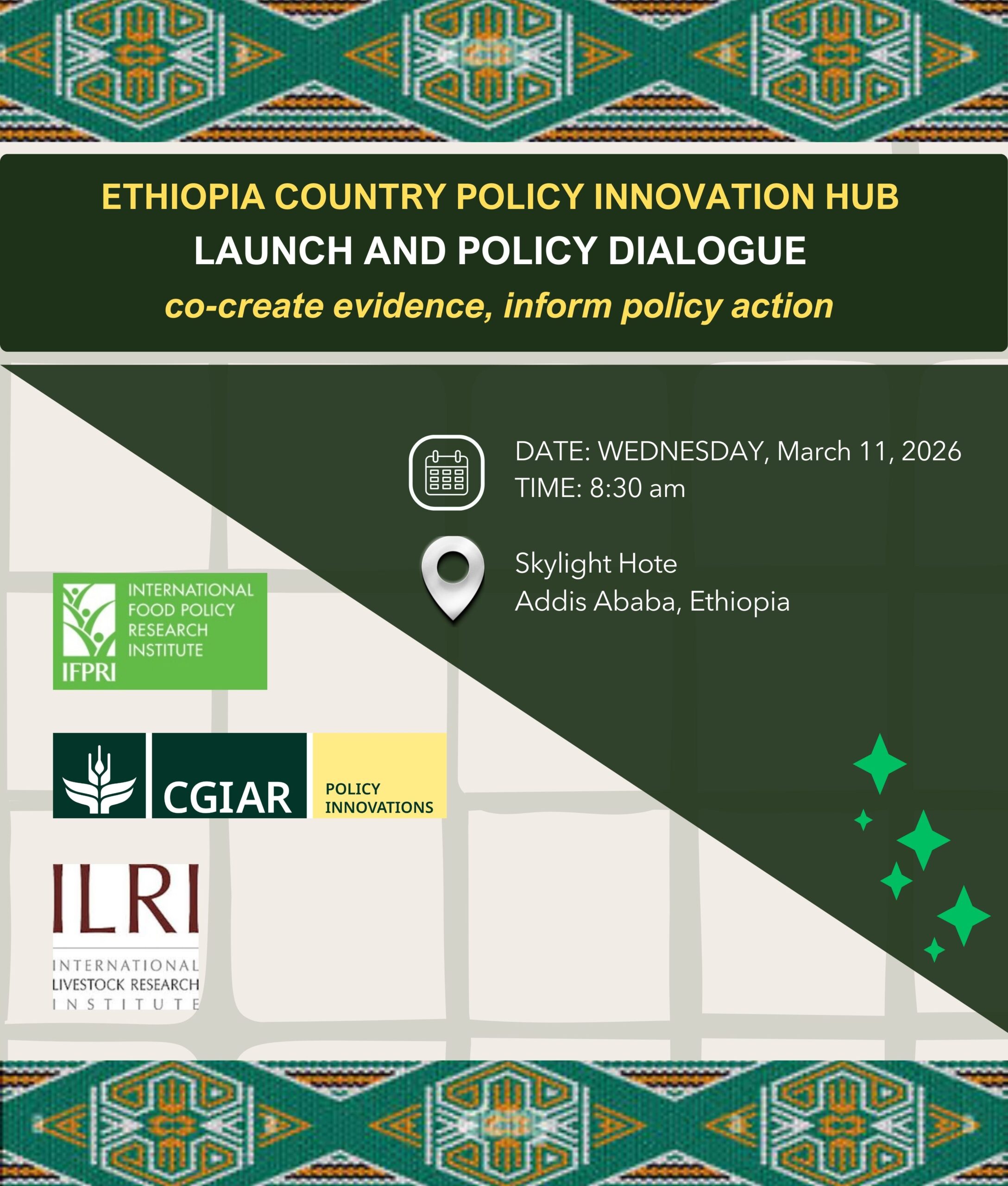
Co-create evidence, inform policy action. March 11, 2026, Skylight Hotel, Addis Ababa, Ethiopia. Starting from 08:30am
The event has two elements:
- Launch the Ethiopia Country Policy Innovation Hub
- Policy Dialogue that informs the portfolio of activities of the Hub (2026-28).
Background
Sustainable and inclusive development is the overarching objective of the government of Ethiopia. This objective is incorporated in core government policies and strategies, including the Home-Grown Economic Reform 2.0, the 10-Year Development Plan (2021-30), the 10-Year Agricultural and Rural Policy (2022-), and the Food Systems Transformation and Nutrition agenda.
The design of specific actions towards achieving policy goals and the effective implementation of those actions require a solid evidence base reflecting in-depth understanding of the specific problems and contexts. In this regard, on the one hand, rapid growth in the country is increasing the complexity of the Ethiopian economy – more businesses with growing size and diversity, new and more technologically advanced sectors, and changing tastes and desires of households both as consumers and investors. On the other hand, considerable changes are buffeting the external environment – climate change and growing global instability are major examples. At the same time, the government is drawing up and implementing comprehensive plans to accelerate structural transformation with the corresponding demand for more fine-tuned policy decisions. All these create and highlight a rising demand for deeper and wider knowledge and evidence. CGIAR centers, in collaboration with local partners, have been contributing to the building of such knowledge and evidence in the country over the years. The Ethiopia Strategy Support Program (ESSP) is an important example in this regard.
The experiences of Country Programs (such as ESSP) and that of the National Policies and Strategies (NPS) Initiative have led to important lessons for designing platforms for linking evidence generation with policy action. Based on those lessons, the Policy Innovations Science Program of the CGIAR has opted to establish Country Policy Innovation Hubs in Ethiopia, India, Kenya, Malawi, and Nigeria.
The Ethiopia Country Policy Innovation Hub
The Ethiopia Country Policy Innovation Hub, like all its counterparts in the other countries, focuses on three core objectives:
- Co-creation: joint development of research and capacity-sharing activities with national partners.
- Evidence-based advice: inform strategies, policies, and investments based on the relevant evidence.
- Capacity sharing: foster capacity co-development, working with national partners to master appropriate and evolving analytics.
The nature and functional modalities of the Hub will be explored during the first part of the Workshop.
Policy Dialogue (2026-28)
The second part of the Workshop is a Policy Dialogue. The Dialogue is the first of a series that will take place in the coming months and, possibly, years. The overall objective of the Policy Dialogue Series is to deepen the mutual learning partnerships between CGIAR policy programs, GoE institutions, national research organizations, and other stakeholders in the generation and use of credible evidence in policy action. Specifically, it aims to serve as one platform for:
- informing current policy discussions and implementation choices by reflecting on insights from previous and ongoing co-created research; and
- scoping and prioritising the country’s demand for research and evidence associated with emerging policy questions, investment needs, and implementation challenges for 2026 and beyond.
In today’s Workshop, the Dialogue focuses on three themes or questions.
- What are the critical policy-relevant evidence gaps constraining the implementation of the food systems transformation and nutrition agenda in 2026-28?
- What is the ranking of these gaps in order of importance and urgency?
- How can the CGIAR and its Ethiopia Country Policy Innovation Hub contribute towards addressing the evidence gaps? What should be its priority areas for 2026-28?
Your participation and insights will help to shape an actionable policy and research framework that supports Ethiopia's ongoing social and economic transformation.
Draft Agenda
| 8:30 AM | Registration | |
| 9:00 – 9:10 AM | Welcome | Alemayehu Seyoum Taffesse, IFPRI |
| 9:15 – 9:30 AM | Opening Remarks | Professor Appolinaire Djikeng, ILRI
Dr. Mandefro Nigussie, ATI |
| 9:35 – 9:50 AM | CGIAR’s Policy Innovation Science Program | Clemens Briesinger, CGIAR |
| 9:55 – 10:25 AM | Introducing the Ethiopia Policy Innovation Hub | Alemayehu Seyoum Taffesse, IFPRI
Getachew Legese Feye, ILRI |
| 10:30 – 10:50 AM | Break | |
| 10:55 AM – 12:15 PM | AoW 1-6 (Q&A 20 minutes) | AoW Leads |
| 12:20 – 1:20 PM | Lunch | |
| 1:25 – 2:45 PM | Policy Dialogue
Session 1A: What are the critical policy-relevant evidence gaps constraining the implementation of the food systems transformation and nutrition agenda during 2026-28? · Dr. Mandefro Nigussie, ATI · Dr Tesfaye Mengistie, MoA · W/ro Sintayehu Demissie, MoA · Dr Sisay Sinamo, MoH · Ato Tsadkan Alemayehu, MoPD |
Getachew Legese Feye, ILRI |
| 2:50 – 3:20 PM | Session 1B:
What is the ranking of these gaps in order of importance and urgency? |
Organizers |
| 3:25-3:45 PM | Break | |
| 3:50 – 4:50 PM | Session 2:
How can the CGIAR and its Ethiopia Country Policy Innovation Hub contribute towards addressing evidence gaps and strengthening evidence-informed policymaking? What should be the priority areas/activities for 2026-28? · Professor Negussie Dachassa, EIAR · Dr. Fisseha Zegeye, MoA · Dr. Namukolo Covic, ILRI · Dr. Dawit Alemu, Wageningen Research · Dr. Tewodros Mekonnen, IGC · Professor Abebe Shimeles, MoF |
Alemayehu Seyoum Taffesse, IFPRI |
| 4:55 – 5:15 PM | Closing | Dr. Tesfaye Mengistie, MoA |
| 5:20 – 6:20 PM | Reception | (to be confirmed) |