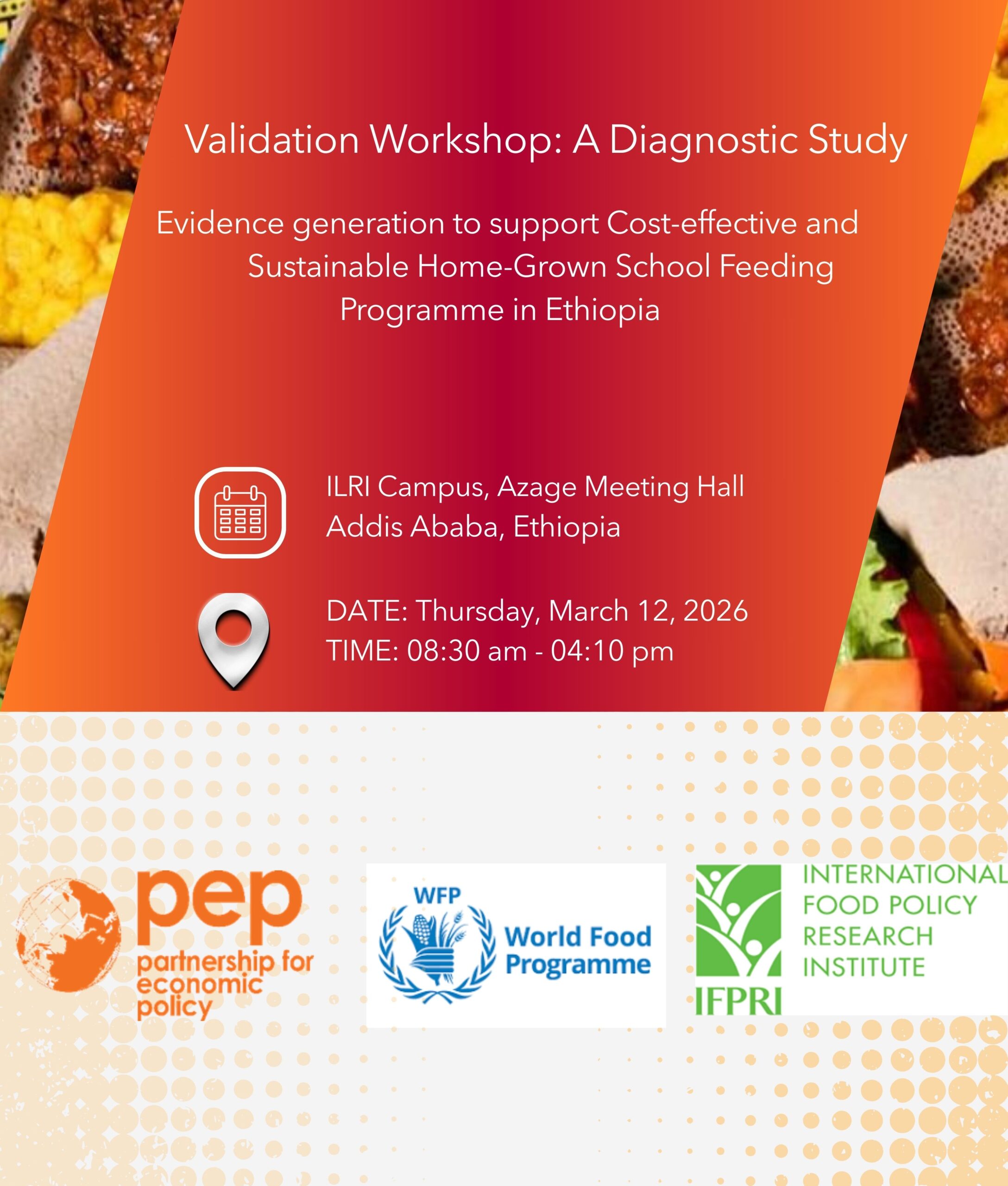
Evidence generation to support Cost-effective and Sustainable Home-Grown School Feeding Programme in Ethiopia
Home-Grown School Feeding Programs have emerged as powerful tools not only to combat undernutrition and enhance child well-being, but also to drive broader socio-economic development. These programs extend beyond simply improving school meals; they are strategically designed to strengthen local food value chains, support local farmers, and stimulate local economies, thereby creating a more resilient and self-reliant agricultural sector. In Ethiopia, school feeding programs were formally initiated in 1994 as an emergency intervention aimed at improving educational outcomes in regions experiencing chronic food insecurity (WFP, 2017).
Ethiopia currently implements several types of Home-Grown School Feeding Program (HGSFP). The HGSFP operates through several delivery models. Despite their growing importance, there is limited systematic evidence characterizing the landscape of the HGSFP in Ethiopia as well as the different models of procurement and delivery of school-feeding services. The school feeding program targets all school children from pre-primary to primary levels, aiming for 100% coverage by 2030 (Ministry of Education, 2021).
The overarching objective of this project is, therefore, to provide evidence to support decisions for improving cost-effectiveness, sustainability, and inclusiveness in HGSFP food procurement systems and related value chains in Ethiopia. Before implementing the proposed interventions, the research team conducted a diagnostic analysis to ensure that the interventions are evidence-based and responsive to existing challenges. During the workshop, key findings from the diagnostic study will be presented, followed by a panel discussion, including practitioners and policymakers actively involved in Ethiopia’s Home-Grown School Feeding Program.
Event Agenda
| 08:30 AM - 08:50 AM | Arrival of Participants and Registration |
| 8:50 AM- 9:00 AM | Traditional Coffee Ceremony and Informal Networking |
| 9:00 AM- 9:10 AM | Welcoming Remarks
Alemayehu Seyoum Taffesse (PhD), Senior Research Fellow and Country Program Leader, International Food Policy Research Institute (IFPRI) |
| 9:10 AM- 9:20 AM | Opening remarks
Yohannes Wogasso (PhD), Director General of School Improvement in Ethiopia, Ministry of Education (MoE) |
| 9:20 AM- 9:30 AM | Introduction and opening about the project
Jane Mariara (Prof.), Executive Director, Partnership for Economic Policy (PEP) |
| 9:30 AM - 9:40 AM | Overview of the CRISP Initiative: IDRC |
| Edidah L. Ampaire, Senior Programme Specialist
International Development Research Centre (IDRC) |
|
| Moderator: Mahlet Mekuria, Program Management Officer, IFPRI-Ethiopia | |
| 9:40 AM - 9:50 AM | Insights from the Field: Snapshot Photos / Short Videos |
| 9:50 AM - 11:00 AM | Overview of the Home-Grown School Feeding Programme project
and findings from the Diagnostic Analysis |
| Q&A and Reflections from Participants
|
|
| Halefom Nigus, Research Fellow, PEP/PSI/IFPRI (Collaborator)
Meseret Wondale, Research Officer, IFPRI-Ethiopia |
|
| Moderator: Tirsit Genye, Research Coordinator, IFPRI-Ethiopia | |
| 11:00 AM - 11:20 AM | Tea Break |
| 11:20 AM - 12:45 PM | Panel Discussion: Navigating the Complexities and Strengthening HGSFP Implementation
Panelists: Yohannes Wogasso (MoE), Taddese Zerfu (IFPRI), Meti Tamirat (AA Mayor Office), Askale Teklu (WFP), Samson Mideksa (EPHI) |
| Moderator: Halefom Nigus, Research Fellow, PEP/PSI/IFPRI (Collaborator) | |
| 12:45 AM – 13:00 PM | Q&A and Reflections from Participants |
| 13:00 PM - 14:00 PM | Lunch Break |
| 14:00 PM - 14:40 PM | Co-Creating the Pathways: Group Work on Priority/Interventions Areas
Groups: (1) Procurement & Local Sourcing, (2) Clean Cooking & Infrastructure, (3) Gender & Value Chain Inclusion, (4) Financing & Sustainability |
| 14:40 PM – 15:00 PM | Presentations and Q&A |
| Moderator: Askale Teklu, Team Leader/Programme Policy
Officer at UNWFP |
|
| 15:00 PM - 15:30 PM | Refining Intervention Pathways Based on Diagnostic Findings and
Outline of Next Steps Q&A and Reflections from Participants |
| Eleni Yitbarek, Associate Professor, University of Pretoria | |
| Moderator: Meseret Wondale, Research Officer, IFPRI-Ethiopia | |
| 16:30 PM - 16:00 PM | Closing Remarks
Askale Teklu, Team Leader/Programme Policy Officer at UNWFP |
| Kibrom Abay/Aulo Gelli, Senior Research Fellow, International
Food Policy Research Institute (IFPRI) |
|
| 16:00 PM | Informal Networking, and Departure |