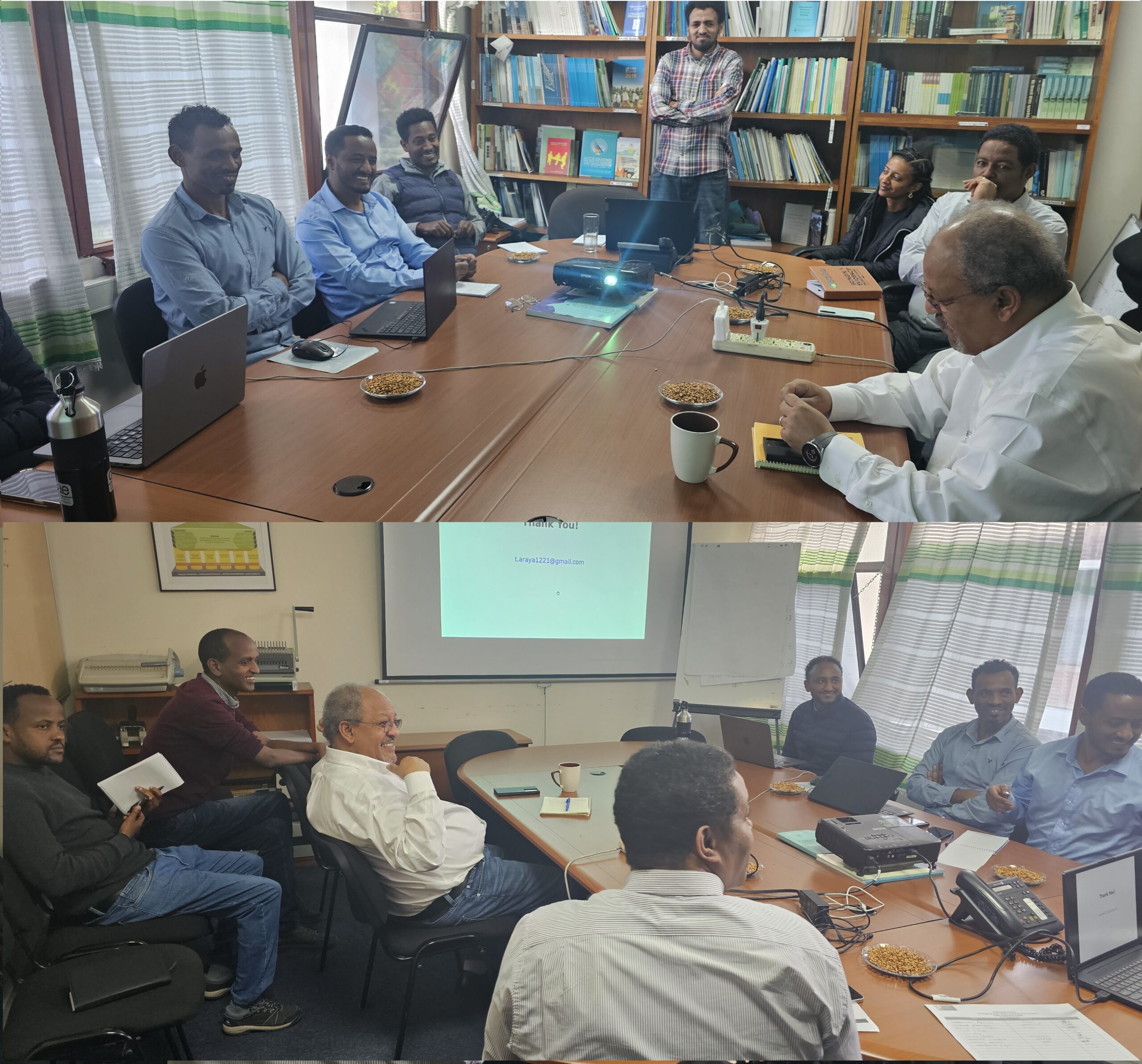
A half-day seminar on “The Impact of Armed Conflict on Food Security in Ethiopia” was held on August 29, 2025, at the IFPRI meeting room, with 11 participants in attendance. The presentation was based on a thesis jointly prepared by Tekelhaymanot Araya, an intern at IFPRI-Ethiopia, and Dr. Gidisa Lachisa of Addis Ababa University.
The research was motivated by the pressing challenge of food insecurity, which continues to affect low- and middle-income countries, particularly in Sub-Saharan Africa. With armed conflicts on the rise, their devastating effects on individuals, households, and communities demand urgent attention. This study contributes to the field by drawing on high-quality panel data collected before and after the conflict through IFPRI’s face-to-face surveys, allowing for a deeper understanding of the conflict–food security nexus in Ethiopia.
Contributions:
- This study contributes presents evidence for the immediate effect and persistence effect of exposure to armed conflict on food security in Ethiopia.
- This study also contributes to the broader development literature on food security and poverty.
- The final contribution of this study identifies the heterogenous effects of exposure to armed conflict on food security based on place of residence (rural vs urban) and gender (female vs male).
Data:
This study investigates the impact of exposure to armed conflict on food insecurity in Ethiopia using two rounds of household panel data collected by the IFPRI in 2019 (baseline) and 2023 (end-line). The key food-security indicators we measured include the Food Consumption Score (FCS) and the Household Dietary Diversity Score (HDDS). An alternative measure of food insecurity, the Food Insecurity Experience Scale (FIES), is also used for a robustness check.
We apply a Difference-in-Differences (DID) estimation strategy to identify the causal relationship between exposure to armed conflict and food (in)security. For a better identification of the causal relationship between exposure to armed conflict and food security, we excluded households that have been exposed to armed conflict between (2016 – 2019).
Results:
The results indicate that exposure to armed conflict significantly reduces food security. Specifically, exposure to armed conflict (one or more battles) leads to a 28% reduction in Food Consumption Score (FCS) and a 13% reduction in Household Dietary Diversity Index (HDDI). Our results show that conflict has a statistically significant and economically large negative effect on food security outcomes.
Conclusion:
This study finds that Armed conflicts is negatively associated with food security. The result indicates that exposure to armed conflict deteriorates food security status.
The adverse effect of exposure to conflict on food security is similar across gender and location. All are affected by the exposure to armed conflict. The results are also robust to the inclusion of the various control variables and also different measures of exposure to conflict.
This highlights the potential mechanisms. The results are robust to alternative measures of food security and exposure to armed conflict. Loss of productive assets, loss of household members, displacement, and uncultivated farmland due to conflict are the key mechanisms that link conflict with food insecurity.
Findings from the research highlight that recovery efforts must go beyond short-term emergency food assistance. Sustainable solutions require the restoration of agricultural systems, targeted support for displaced populations, and investment in rural infrastructure. Equally critical are strengthening social protection programs such as the Productive Safety Net Program (PSNP), improving access to credit and agricultural inputs, and enhancing market connectivity. Together, these measures can play a pivotal role in rebuilding resilience and ensuring long-term food security in Ethiopia.