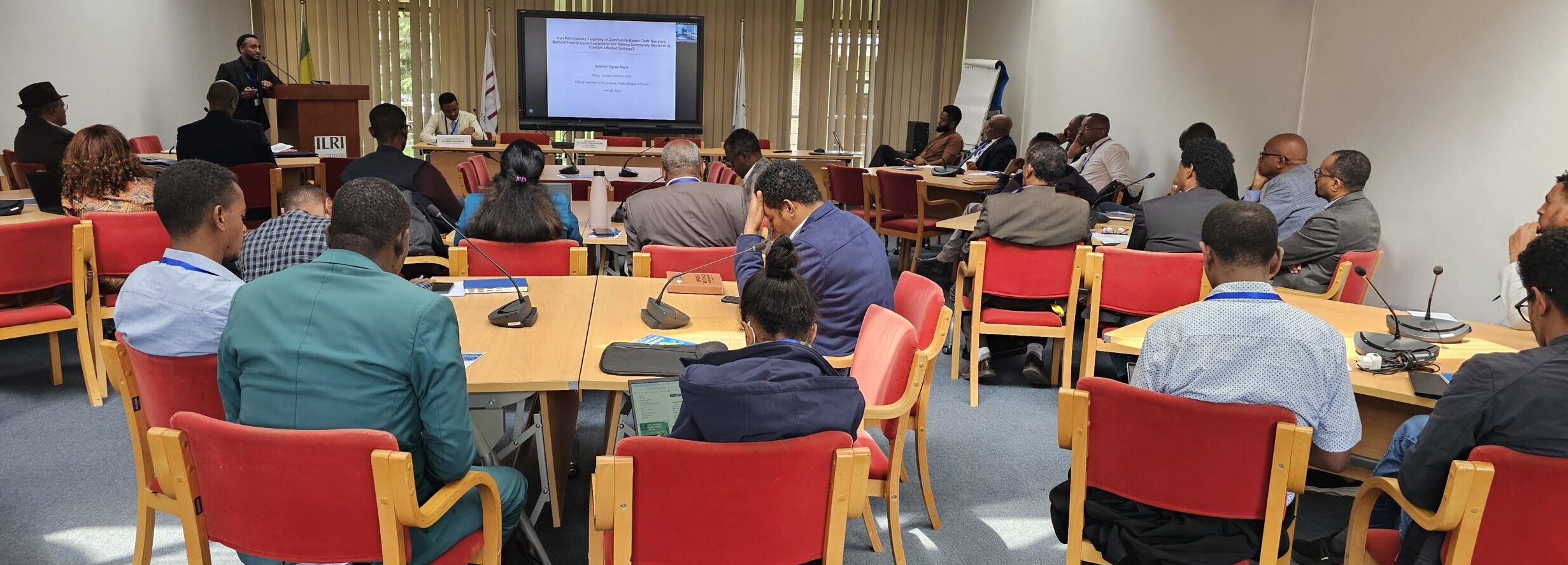
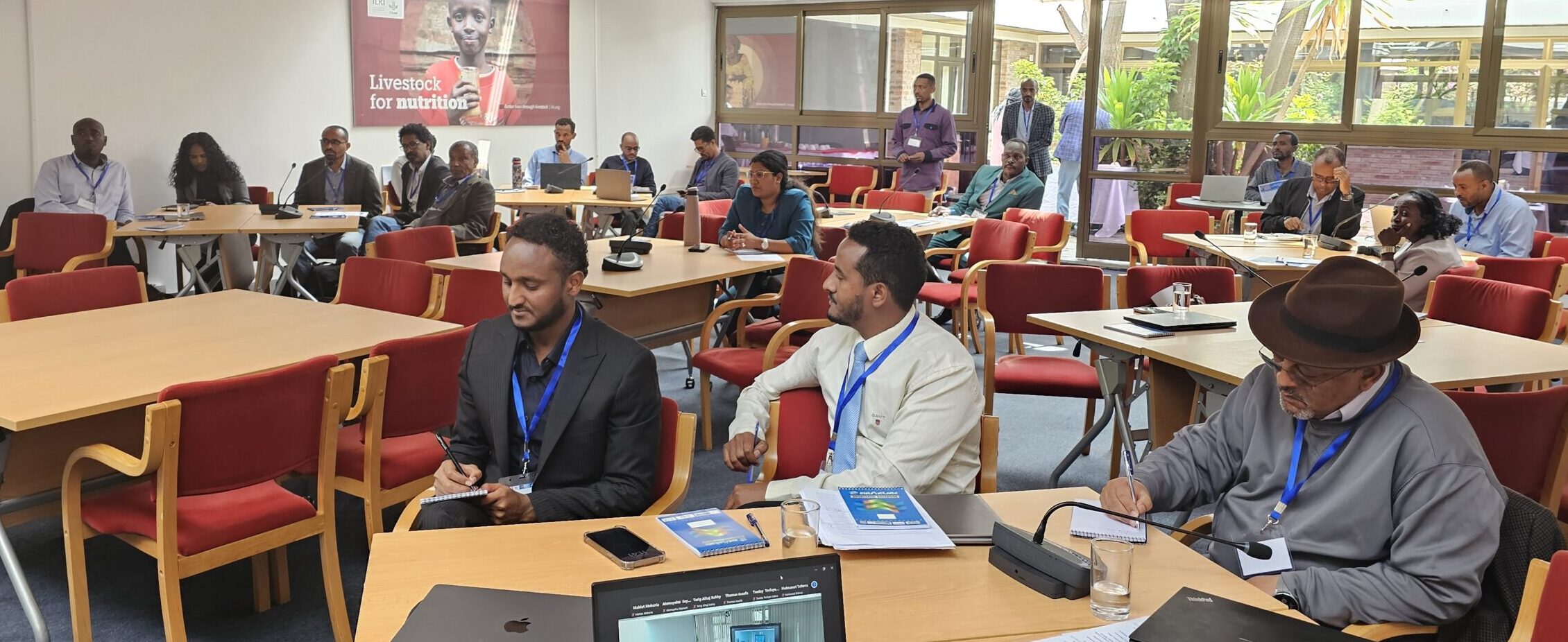
With the participation of over 40 attendees from government institutions, the private sector, research institutes and educational institute, the long-anticipated half-day seminar titled "Rebuilding Trust in Local Governance in Conflict-Affected Settings" took place on June 26, 2025, at the ILRI Campus in Addis Ababa, Ethiopia. The event was co-organized by IFPRI, IGC, CGIAR-Policy Initiative, and CGIAR-FSS programs. The seminar commenced with opening remarks from Alemayehu Seyoum Taffesse of IFPRI-Ethiopia and Tewodros Gebrewolde of IGC. An engaging discussions were made between the participants following the presentation on "Rebuilding Trust in Local Leadership in Conflict-affected Settings: The Impact of Community-based Cash Transfers" by Alemayehu Seyoum Taffesse and on "Participatory Targeting of Community-based Cash transfers for Rebuilding Trust in Local Governance in Conflict-Affected Settings" by Halefom Nigus.
A panel discussion was held featuring a dynamic and insightful discussion by a diverse panel of experienced experts, who offered compelling perspectives on the challenging issue of how to rebuild trust in local governance, particularly in conflict-affected settings.
A representative from the Ministry of Peace, Dr. Awoke Atinafu Adam, PhD, Chief executive Peacebuilding, Ministry of Peace outlined the multifaceted challenges and efforts in promoting peacebuilding across Ethiopia. Highlighting conflict-affected areas such as parts of Benishangul-Gumuz, Afar-Somali borders, and Southern Ethiopia, Dr. Awoke emphasized that ethnic tensions, identity-based disputes, resource competition, and lack of service delivery continue to erode trust between communities and government institutions. The displacement of people and breakdown of social cohesion, combined with corruption, misinformation, and weak institutional accountability, were identified as major barriers to peace and stability.
To address these issues, the Ministry has initiated several strategies focused on grassroots peacebuilding. Central to these efforts is the promotion of community dialogues and reconciliation mechanisms, empowering local leaders, and increasing transparency and accountability. Initiatives include a proposed national displacement regulation law, peace index assessments, and capacity-building through tailored training manuals. The Ministry is also scaling up inclusive programs that integrate humanitarian aid, development, and security responses, with a strong emphasis on gender-sensitive approaches and decentralized governance. Through these coordinated efforts, the Ministry aims to rebuild trust, strengthen local resilience, and promote sustainable peace across the country.
In this insightful speech, Dr. Yonas Adaye Adeto, PhD, Associate Professor of Peace Studies, Addis Ababa University. Commissioner, the Ethiopian National Dialogue Commission highlights the vital role of national dialogue in rebuilding trust and achieving sustainable peace in Ethiopia. Emphasizing the erosion of the social contract and the rise of ungoverned spaces, Dr. Yonas argues that true dialogue—rooted in listening, inclusivity, and cultural understanding—is the only viable path forward. Trust, must be rebuilt gradually, through both bottom-up and top-down approaches, involving communities, youth, women, the diaspora, and even armed groups, whose ideas must be heard if not directly voiced. Ultimately, he calls for a holistic view of trust that encompasses spiritual, cultural, political, and emotional dimensions—replacing the winner-takes-all mentality with a culture of peace by peaceful means.
As an academician, Dr. Yonas shared his observation on the role of universities’ and academic institutions’ intervention in rebuilding trust in post-conflict settings. He advocates for a cosmopolitan and indigenous approach to peacebuilding in Ethiopia, rooted in rebuilding relationships and trust that once bound the nation. Emphasizing the value of traditional systems like Gadaa, Gurti, and Inderta, Dr. Yonas criticizes the reliance on Western frameworks and calls for a decolonization of both methodology and mindset. He argues that sustainable peace must be shaped by Ethiopia’s communal values— “I am because we are”—and by fully engaging universities, intellectuals, and political leaders in grassroots-driven dialogue and reconciliation. The message is clear: lasting peace requires both honoring indigenous wisdom and uniting all sectors of society in a shared national effort.
Dr Fana Gebresenbet, PhD, Director, Institute for Peace and Security Studies, AAU draws on academic experience to emphasize the need for interdisciplinary and participatory approaches to peacebuilding in Ethiopia. He highlights that rebuilding trust and social cohesion after conflict requires more than material interventions—it demands platforms for engagement between communities, governments, and other actors. By distinguishing between bonding and bridging social capital, and horizontal and vertical cohesion, Dr. Fana calls attention to the scale and complexity of peacebuilding in a multi-ethnic, politically layered context. He stresses that academics must engage beyond disciplinary boundaries, embrace complexity, and recognize that peacebuilding is inherently political, not just technical or bureaucratic.
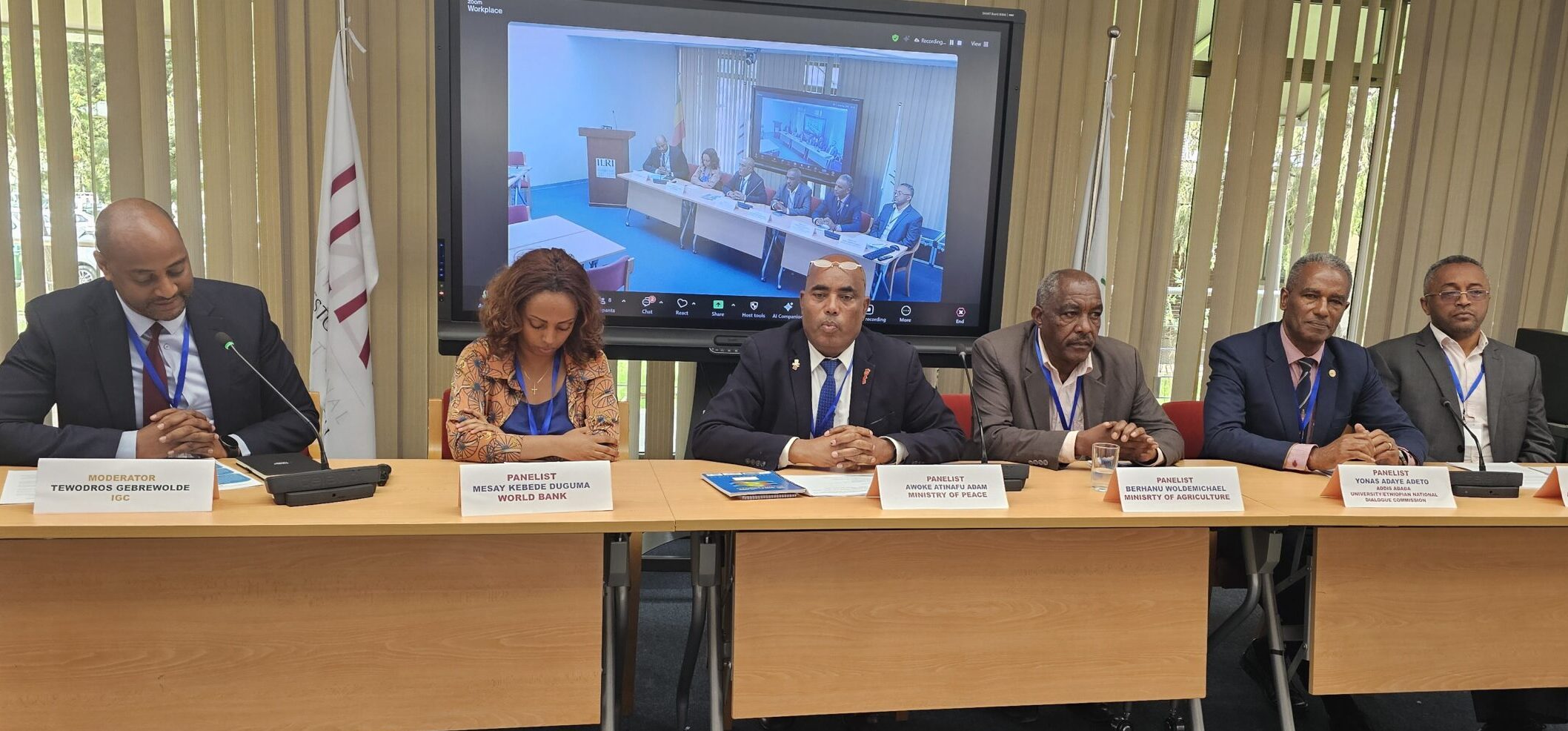
Ato Berhanu Woldemichael, Food Security Coordination Office, Ministry of Agriculture (MoA) highlights the critical role of Ethiopia's Productive Safety Net Program (PSNP) in not only alleviating poverty but also in rebuilding trust and promoting stability in conflict-affected rural areas. Through regular cash transfers—both manual and electronic—the program helps protect households from asset depletion and food insecurity, while engaging able-bodied recipients in public works that benefit entire communities. Its grassroots implementation structure, involving diverse local stakeholders like women, elders, and religious leaders, fosters transparency, accountability, and local ownership. Ato Berhanu emphasizes that for social protection programs like PSNP to be truly effective, they must be sustained, inclusive, and strategically designed to achieve dual goals: poverty reduction and peacebuilding.
Representing the WorldBank, Dr. Mesay Kebede Duguma, PhD, Social Protection, Research, Programme Design Consultant of World Bank underscores the growing recognition of social protection programs—particularly cash transfer schemes like Ethiopia’s Productive Safety Net Program (PSNP)—as powerful tools for rebuilding trust in local institutions and promoting social cohesion in post-conflict settings. Again speaking from a World Bank perspective, Dr. Mesay highlights how embedding such programs within government structures and ensuring wide coverage, system development, and community involvement enhances their legitimacy and effectiveness. When designed inclusively and implemented transparently—with digital systems, grievance mechanisms, and targeted support to marginalized groups—social protection can empower communities, foster accountability, and reinforce the legitimacy of state actors at the grassroots level.
The meeting is adjourned at 01:00pm by Alemayehu Seyoum Taffsse’s closing remark.
In closing the discussion, Dr. Alemayehu emphasized that conflict significantly erodes trust in local institutions, with ripple effects on community well-being. However, targeted social protection programs—such as cash transfers—can play a vital role in restoring that trust, provided they are well-designed and participatory. He stressed that trust-building and peacebuilding are long-term, complex processes requiring engagement from both citizens and institutions. The session reinforced the need for continued dialogue, research, and policy innovation, particularly around participatory approaches to social protection. Finally, he clarified that his emphasis on external cash transfers was methodological, not ideological, and concluded by calling for more platforms that blend research and policy for meaningful impact.
Finally, Dr. Alemayehu expressed his appreciation to the CGIAR Policy Innovation Science Program—highlighting its three central pillars: promoting science-based policy decisions, driving investments, and supporting institutional change—as well as to CGIAR FSS for co-organizing the event alongside the International Growth Centre (IGC) and International Food Policy Research Institute-Ethiopia Strategy Support Program (IFPRI-ESSP).